NEW-LEADERSHIP TRAINING. For
aspiring Himalayan leaders.
08' Full - waitlist only- Everest Altitude Training-
Aconcagua available. Next program Feb. 6 to Feb. 23- 2008. For
more....
TRAIN FOR
EVEREST- There is no better place to train for Everest than
in the Himalayas. Learn and test skills needed to climb big
mountains.
During our
Mt. Pumori expedition in Nepal each autumn we learn to rope
up, tie in and climb together on the one of the most impressive
mountains in the world.
Many climbers
are under the impression they have to climb an 8000m peak like
Cho Oyu or peaks like Aconcagua or Denali to learn how your body
does at altitude. We believe that if your body has acclimatized
to 7000m with success, it demonstrates your body has the ability
to adjust , which is key.
On Pumori you will learn far more than just being on a high
altitude walk. Safety should be the entire basis of a training
climb and there is no better place to learn. Join Tim Rippel-
Mountain Rescue, Altitude Mountain Guide/Instructor and Mountain
Safety professional for over 20 years
EVEREST
ALTITUDE TRAINING- Aconcagua.
This past year successful Everest summits by various climbers
including two Peak Freak members, made a trip to Aconcagua
pre-Everest. This is a non-technical peak offering excellent
altitude prior to an Everest bid. Acclimatization can stay
with you up to three weeks or more making this trip an excellent
pre-Everest card to put your pocket. For
more...
Our
Mt. Pumori
mountaineering course is designed for the beginner to intermediate
climber. The program is for aspiring climbers wishing to develop strong
fundamental skills in all aspects of snow and alpine climbing and while at
altitude. Altitude training is essential for Mt. Everest. The course
serves an excellent prerequisite for Mt. Everest or any other technical or
high altitude peak. Many climbers claim that Mt. Everest is
not a technical peak which we agree. Everest, from our years of experience
is about stamina, ability to adjust to altitude, team work, being
self-reliant in the mountains, identifying risk and more importantly, a
positive attitude. We believe our Everest training climbs are the
best there is. After taking this course one should feel mentally prepared
and experience "WISE" for high altitude mountain climbing. An
excellent opportunity to meet your leader and sherpa team in the
mountains, whilst getting acquainted with local customs, weather patterns
all while focusing on the world's largest mountaineering objective
"Mt. Everest" which is standing directly in front of you.
Visualization is a powerful
tool when training physically and preparing mentally.
On
summit day when all your energy is spent and nothing seems to be working
like it used to , it is your mind that will pull you through.
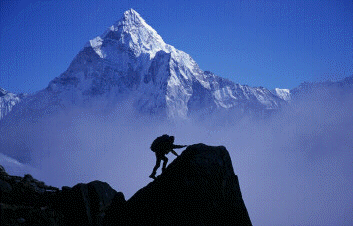
Mt.
Pumori offers the best training ground in the world for
climbers who aspire to climb Mt. Everest or any other high
altitude peak.
ON EVEREST
TRAINING- Kala Pattar
to Camp1 and Camp 2
Mar.23- Apr.27,
2009
10,000US
ON EVEREST
OPTION Camp 1,
Camp 2 and Camp 3
Mar. 23- May 1,
2009
11,500US
COURSE
OBJECTIVES
PUJA- Ceremony
blessing equipment
Testing Equipment
Acclimatization
Training
Traversing
Learning and practicing
technical and practical knowledge in all aspects of snow and alpine
climbing expedition style including:
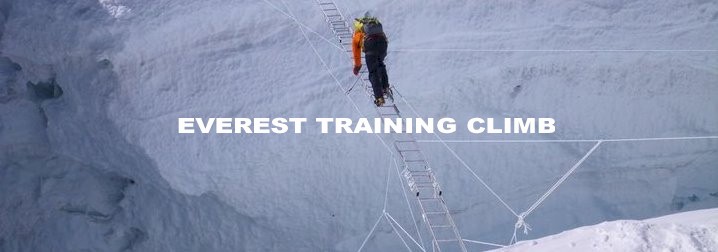
Glacier Travel and use of
ladders
Rope/Belay techniques
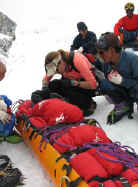
Crevasse rescue
Route finding
Self arrest
Rappelling
Pacing oneself at altitude
Safe climbing in crowds
Use of crampons on ladders
Fixing ropes and traveling
on fixed lines.
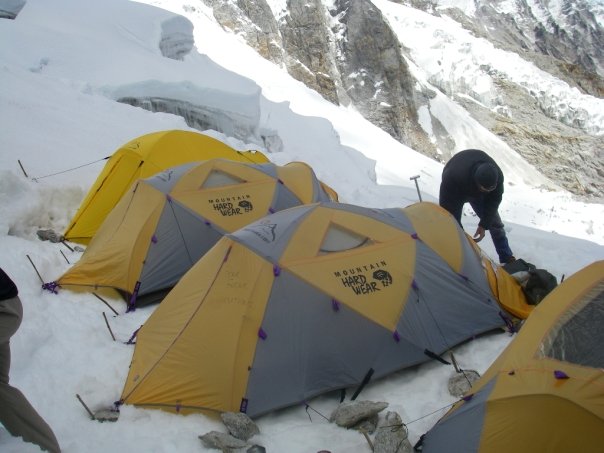
Building high altitude
camps do's and don'ts.
Boiling water at altitude,
fuel and stove alterations for high altitude climbing.
Food preparations, do's
and don't of cooking and packing at altitude.
Developing
educated self-reliant climbers with the ability to evaluate
subjective/objective hazards expedition style including:
Rock
Fall
Glacier
conditions
Critical
decision-making
Group
experience
White
out navigation
Mountain
weather conditions general
AMS-
Acute mountain sickness: Signs, symptoms and treatment.
Safe
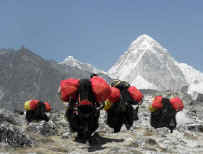
travel on trails and routes with yaks and zomo's and including unique
rules of the trail in sherpa land.
Himalayan
specific:
Use
of oxygen
High
altitude gear evaluations and care
Sherpa,
culture, customs and their role on an expedition
Everest
Mountain Weather
Nepalese
Liaison Officers and Chinese Liaison Officers and their roles
Permits,
restrictions, environmental issues, procedures and waste disposal.
Communications,
language barriers, sat phones, hand radios.
Religious
considerations of the region.
Health
management
High
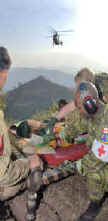
altitude helicopter rescue and protocol
To
yak or not to yak spiritual rescue protocol
Expedition
logistics, permits, liaisons etc.
Ice-Fall
doctors and their role on Everest.
Team
negotiations with regards to shared rope and fixing routes on the
mountains.
Negotiating
shared camp space with other expeditions in the region.
Negotiating
summit bid time slots with other expeditions in the region.
Climbing with fixed
ropes
Emergency shelter
building
Establishing Camps
PHYSICAL
CONDITIONING
In
the best interest of personal safety, success and team compatibility,
adequate training physical condition is required. Prior climbing
experience of carrying a heavy pack for multiple days serves as an
excellent preparation for this course; Climbers must be able to carry an
average of 15kg to 20kg. Good cardio will serve you well
for attaining proper acclimatization in good time.